Global web icon
grammarly.com
https://www.grammarly.com/blog/sentences/condition…
The 4 Types of Conditional Sentences - Grammarly
Learn what conditional sentences are, the different types of condition sentences, and how to use them in written English.
Global web icon
perfect-english-grammar.com
https://www.perfect-english-grammar.com/conditiona…
CONDITIONALS - Perfect English Grammar
If I study conditionals, I will speak better English! That's the first conditional - find clear explanations and lots of practice exercises here.
Global web icon
britishcouncil.org
https://learnenglish.britishcouncil.org/grammar/b1…
Conditionals: zero, first and second | LearnEnglish
Test what you know with interactive exercises and read the explanation to help you. Look at these examples to see how zero, first and second conditionals are used. If you freeze water, it becomes solid. If it rains tomorrow, I'll take the car. If I lived closer to the cinema, I would go more often. Try this exercise to test your grammar.
Global web icon
grammarinsights.com
https://grammarinsights.com/english-grammar/condit…
What Are Conditionals in Grammar? Types and Examples
A conditional sentence expresses a condition (often introduced by “if”) and a result (the consequence of that condition being fulfilled). Essentially, it’s an “if-then” statement: if something happens or had happened, then something else will or would occur.
Global web icon
englishstudyonline.org
https://englishstudyonline.org/conditionals/
Conditionals in English: 5 Types, Formulas & Practice Exercises (2026)
In this guide, you’ll learn the definition of conditionals, clear formulas, the four main types of conditional sentences, and practical examples to help you use them correctly.
Global web icon
lingolia.com
https://english.lingolia.com/en/grammar/conditiona…
Conditionals & If Clauses in English Grammar - Lingolia
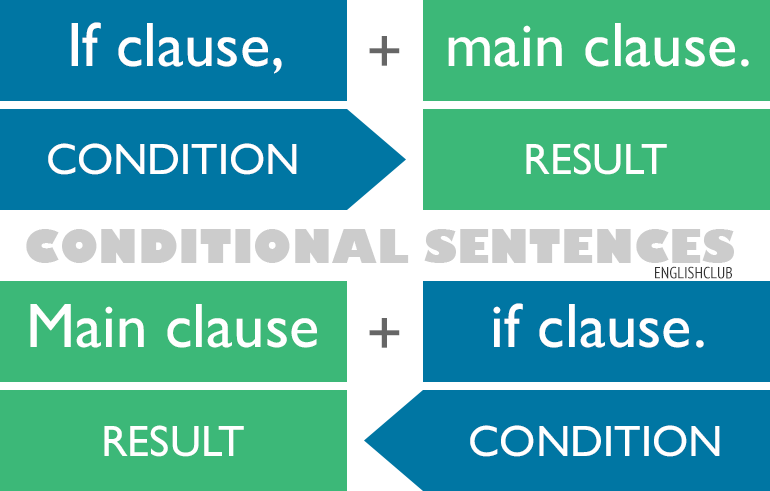
What is a conditional? Conditionals are if clauses: they express a situation or condition and its possible result. They are made up of two clauses; the conditional clause and the main clause. The former usually starts with the word if and sets out a condition, while the latter expresses what happens when this condition is fulfilled.
Global web icon
vocaberry.com
https://vocaberry.com/grammar/conditionals-in-engl…
Conditionals in English – Zero, First, Second, Third and Mixed
Conditionals are sentences used to express what will happen, could happen, or might have happened, depending on a condition. These sentences are often built with an “if clause” (the condition) and a “main clause” (the result).
Global web icon
englishclub.com
https://www.englishclub.com/grammar/verbs-conditio…
Conditionals | Learn English
IF IT RAINS, I WILL STAY HOME. That's a conditional! Learn 1st, 2nd, 3rd and zero conditionals in English, with example sentences + quizzes.
Global web icon
ef.edu
https://www.ef.edu/english-resources/english-gramm…
Conditional | EF United States
Conditional tenses are used to speculate about what could happen, what might have happened, and what we wish would happen. In English, most sentences using the conditional contain the word if. Many conditional forms in English are used in sentences that include verbs in one of the past tenses.
Global web icon
grammar.cl
https://www.grammar.cl/english/conditionals.htm
Conditionals and IF clauses in English - Grammar
Conditional sentences have two parts: the if-clause and the main clause. Example sentence: If it rains, I will cancel the trip. If it rains is the if-clause and I will cancel the trip is the main clause. The IF-clause introduces a condition. The main clause is the result of that condition.